변유열은 알고리즘적 인터폴레이션을 통해 디지털 데이터가 지닌 불연속성의 한계를 횡단하며 기술과 사유, 실재 사이의 접점을 탐구한다. 그는 고정된 정보가 어떻게 유동적인 진실로 변이되는지에 주목하며, 정적인 객체 너머의 미시적 진동을 포착해 세계를 끊임없이 공명하는 역동적인 ‘사건’의 연쇄로 가시화하는 작업을 이어오고 있다.
Yuyeol BYEON explores the intersection between technology, thought, and reality by traversing the limits of digital discontinuity through algorithmic interpolation. Focusing on how fixed data mutates into fluid truths, he captures the microscopic vibrations beyond static objects, visualizing the world as a dynamic sequence of resonating ‘events’ in perpetual transition.
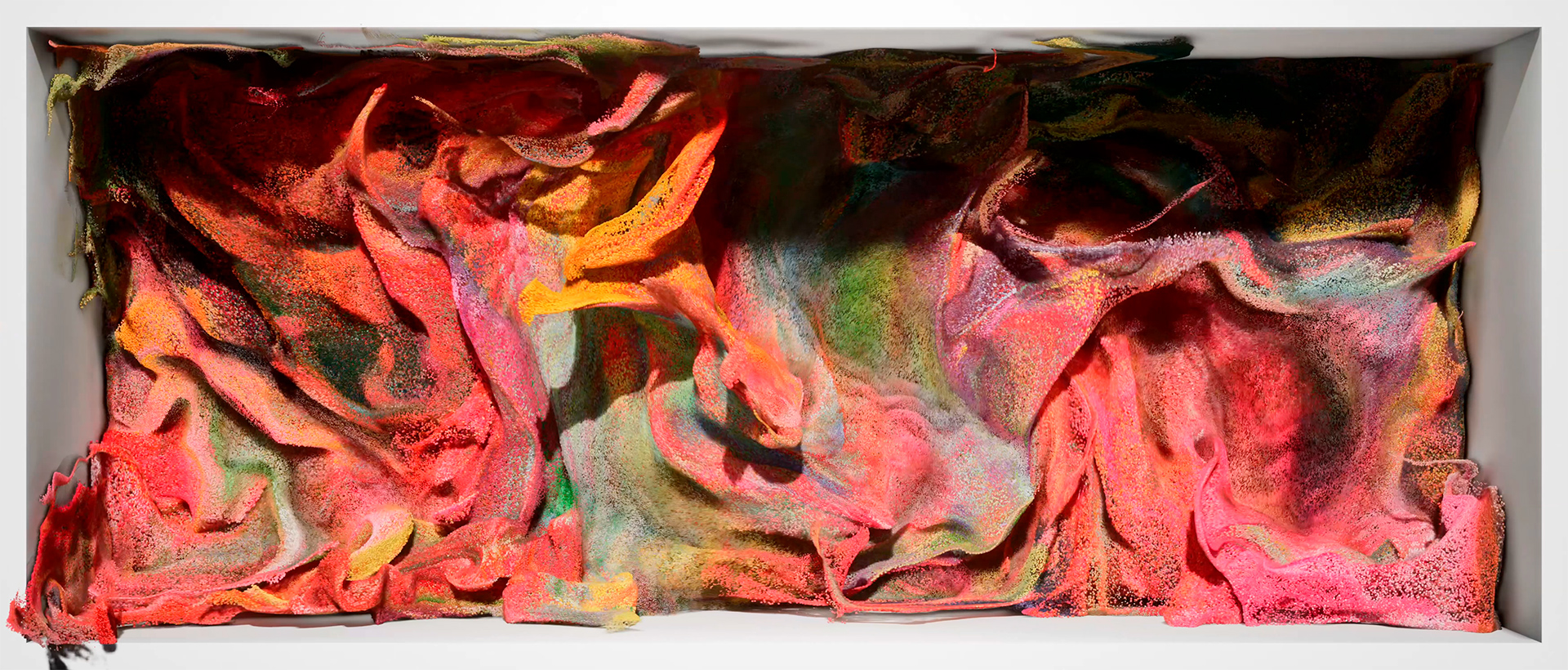
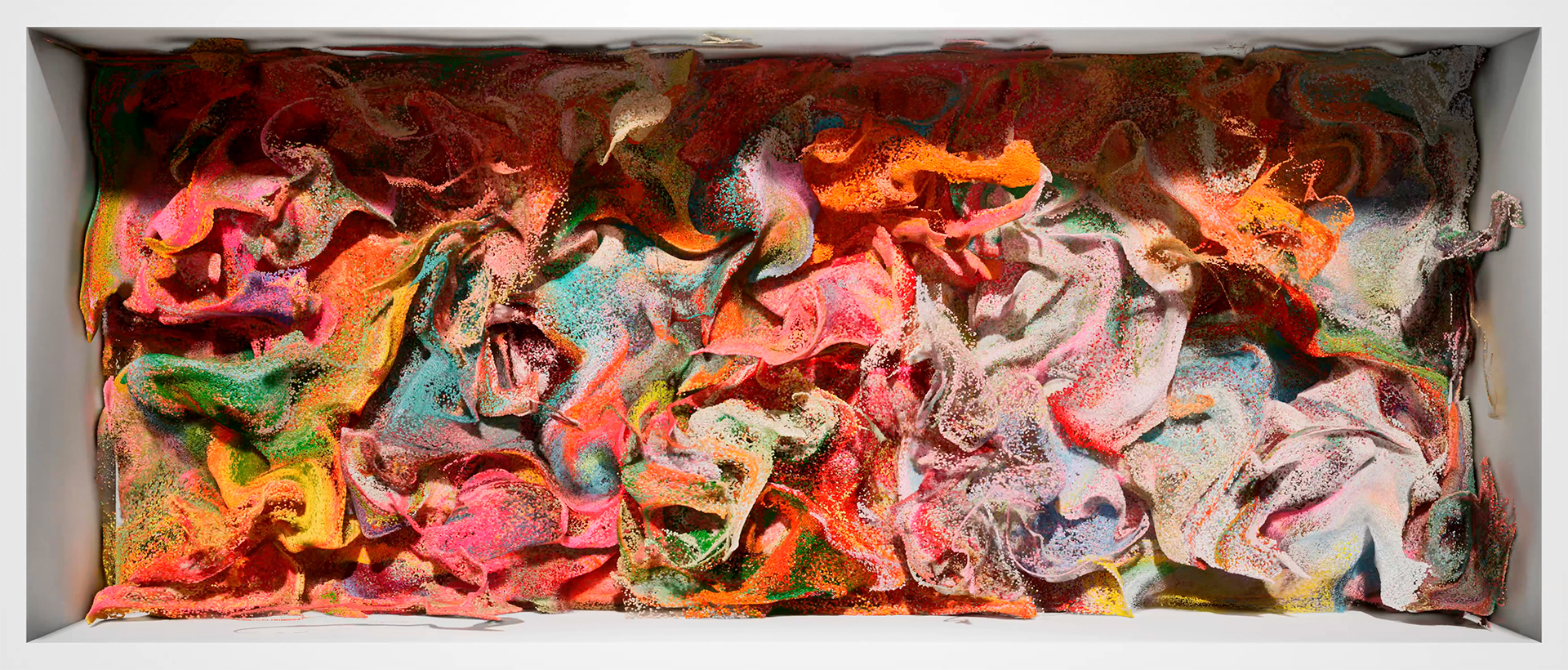
〈Data Flow: Rokkaku〉는 Ayako Rokkaku의 개인전 《Breathing with the Chaos》에서 파생된 전시 이미지 데이터를 기반으로 제작된 미디어아트 영상 작품이다. 전시에서 생성된 회화 이미지는 완결된 결과물로 고정되지 않고, 이후 변환 가능한 데이터 구조로 다루어졌다.
작가는 Ayako Rokkaku의 회화적 행위의 결과로 남은 이미지 데이터를 정지된 평면 정보로 두지 않고, 그 데이터에 시간성·공간성·운동성을 부여하는 방법을 모색하였다. 회화의 결과는 데이터셋으로 전환되었고, 데이터는 생성 모델의 잠재공간을 통과하며 확률적 구조로 재배열되었다. 이 과정에서 이미지의 표면적 형상은 고정된 의미 단위가 아니라, 재조합 가능한 잠재 벡터의 분포로 전환되었다.
잠재공간에서 형성된 데이터는 다시 3차원 디지털 시뮬레이션 공간으로 이동하였다. 이 과정에서 이미지 데이터는 물리 엔진 안에서 동역학적 거동으로 변환되도록 설정되었다. 색상 정보는 유체의 속도, 난류, 노이즈 값 등 물리 변수로 환원되었으며, 동시에 파티클에 입혀지는 색 데이터로 사용되었다. 회화의 색은 표면적 인상이 아니라 물리적 운동을 발생시키는 수치값으로 기능하였다.
시뮬레이션은 3차원 공간에서 계산되지만, 최종 출력은 다시 2차원 평면의 영상 이미지로 구성된다. 회화적 제스처는 데이터가 되고, 데이터는 잠재 벡터가 되며, 잠재 벡터는 물리 시뮬레이션 구조로 전환된 뒤 다시 2차원 이미지 연속체로 환원된다. 이 순환 구조 안에서 회화는 원본과 복제의 위계가 아니라, 서로 다른 상태를 거치는 변환체계로 위치한다.
데이터는 작품 안에서 단순한 기록물이 아니라 이동하고 변형되며 재구성되는 존재로 다루어진다. 회화는 데이터로 전환되고, 데이터는 잠재공간에서 분산되며, 다시 물리 시뮬레이션을 통해 운동성을 획득한다. 이러한 데이터의 여정은 회화 작품의 본래적 가치를 단일한 원본성에 두지 않고, 잠재성의 분포와 변환 가능성 안에서 재배치한
다. 이는 이미지의 위계 구조를 고정하는 대신, 데이터 생태학적 순환 속에서 관계적 구조로 전환하는 방식으로 구성되었다.
이와 같이 〈Data Flow〉는 2차원 평면 회화를 잠재공간의 데이터로 전환하고 이를 3차원 시뮬레이션 공간으로이동시킨 뒤, 다시 시간성·공간성·운동성을 지닌 평면 영상으로 환원하는 구조를 형성한다. 데이터의 이동 경로 자체가 작품의 구조로 작동한다.
- 데이터 정제 (Data Curation & Normalization)
전시에서 파생된 원천 이미지 중 작업 목적에 부합하는 이미지 10장을 선별하였다. 이후 해상도, 비율, 컬러 포맷을 통일하고 노이즈를 제거하였다. 모든 이미지는 동일 규격으로 정규화되어 생성 모델 학습에 적합한 데이터셋으로 구성되었다. - DiffMorph 기반 모핑 시퀀스 생성 1
정제된 이미지를 키프레임으로 설정하고 DiffMorph 모델을 사용하여 이미지 간 잠재공간 보간과 워핑 기반 모핑을 수행하였다. 중간 프레임이 자동 생성되었으며, 개별 이미지 사이의 변환은 연속적인 시퀀스로 구성되었다. - 데이터 증강 (Data Augmentation)
생성된 모핑 시퀀스를 통합하여 3000장 이상의 학습용 데이터셋 이미지로 확장하였다. 회전과 크롭 등 기하학적 변형을 중심으로 데이터 다양성을 확보하였다. 색상 정보는 원본 데이터의 회화적 특성을 보존하기 위해 변형하지 않았다. - StyleGAN3 학습 및 벡터 인터폴레이션 2
증강된 데이터셋을 StyleGAN3 모델 학습에 사용하였다. 약 72시간의 학습 완료 후, 잠재공간에서 벡터 인터폴레이션을 수행하여 연속적인 생성 이미지 시퀀스를 출력하였다. - Unreal Engine 기반 유체역학 환원
생성된 이미지 시퀀스를 Unreal Engine 환경으로 가져와 유체역학 시뮬레이션 머테리얼의 텍스처로 사용하였다. 각 프레임의 RGB 색상 데이터는 수치값으로 변환되어 유체의 속도 강도, 난류, 노이즈 진폭, 파동 주파수 등의 물리 변수에 매핑되었다. 동시에 해당 색상 데이터는 파티클 시스템에 적용되어 개별 파티클의 발색 정보로 사용되었다.
3차원 시뮬레이션 공간에서 계산된 유체 거동은 영상 렌더링을 통해 2차원 이미지 연속체로 출력되었다. 최종 결과는 유체역학 시뮬레이션 기반의 파동 구조 영상으로 구성되었다.
Data Flow: Rokkaku is a media art video work produced from exhibition image data derived from Breathing with the Chaos, a solo exhibition by Ayako Rokkaku. The paintings generated in the exhibition are not treated as fixed, completed results, but as transformable data structures.
The artist does not leave the resulting image data of Rokkaku’s painterly actions as static planar information, but instead explores ways to assign temporality, spatiality, and motion to it. The outcomes of painting are converted into datasets, which pass through the latent space of a generative model and are reorganized into probabilistic structures. In this process, the surface form of the image is no longer a fixed unit of meaning, but becomes a distribution of recombinable latent vectors.
The data formed in latent space is then transferred into a three-dimensional digital simulation environment. Here, image data is configured to transform into dynamic behavior within a physics engine. Color information is reduced to physical variables such as fluid velocity, turbulence, and noise values, while simultaneously being applied as color data to particles. Color in painting thus functions not as a surface impression but as a numerical value that generates physical motion.
Although the simulation is computed in 3D space, the final output is again presented as a two-dimensional moving image. Painterly gestures become data; data becomes latent vectors; latent vectors are transformed into physical simulation structures; and these are ultimately reduced back into a sequence of 2D images. Within this cyclical structure, painting is positioned not within a hierarchy of original and copy, but as a system of transformation across different states.
Data in this work is not treated as a static record, but as an entity that moves, transforms, and recomposes itself. Painting is converted into data, dispersed in latent space, and then regains motion through physical simulation. This trajectory relocates the value of painting away from singular originality toward distributions of potentiality and transformability. Instead of fixing hierarchical structures of images, the work constructs a relational system within a data-ecological cycle.
Thus, Data Flow forms a structure in which two-dimensional painting is converted into latent-space data, transferred into a three-dimensional simulation environment, and then reduced again into a time-based, spatial, and kinetic planar image. The pathway of data itself becomes the structure of the work.
- Data Curation & Normalization
Ten images were selected from the exhibition-derived source images based on relevance to the project’s objectives. Resolution, aspect ratio, and color format were unified, and noise was removed. All images were normalized into a consistent format suitable for training generative models. - DiffMorph-based Morphing Sequence Generation
The curated images were set as keyframes, and latent space interpolation and warping-based morphing were performed using the DiffMorph model. Intermediate frames were automatically generated, forming continuous sequences between images. - Data Augmentation
The generated morphing sequences were expanded into a dataset of over 3,000 training images. Geometric transformations such as rotation and cropping were applied to ensure diversity, while color information was preserved to maintain the painterly qualities of the original data. - StyleGAN3 Training & Vector Interpolation
The augmented dataset was used to train a StyleGAN3 model. After approximately 72 hours of training, vector interpolation within latent space was performed to generate continuous image sequences. - Fluid Dynamics Translation in Unreal Engine
The generated image sequences were imported into Unreal Engine and used as textures for fluid dynamics simulation materials. RGB color data from each frame was converted into numerical values and mapped to physical parameters such as velocity intensity, turbulence, noise amplitude, and wave frequency. Simultaneously, the same color data was applied to a particle system as color attributes.
The fluid behavior computed in the three-dimensional simulation space was rendered into a two-dimensional image sequence. The final output consists of a video structured as waveforms generated through fluid dynamics simulation.